Transfusion Science bench
The Transfusion Science bench is a simulated hospital laboratory bench with 22 procedures and 292 cases, covering pre-analytical, serology, issue, special cases and quality. Every scored answer links to the UK source it rests on: BSH guidelines, SHOT, the JPAC Red Book and manufacturers' instructions for use.
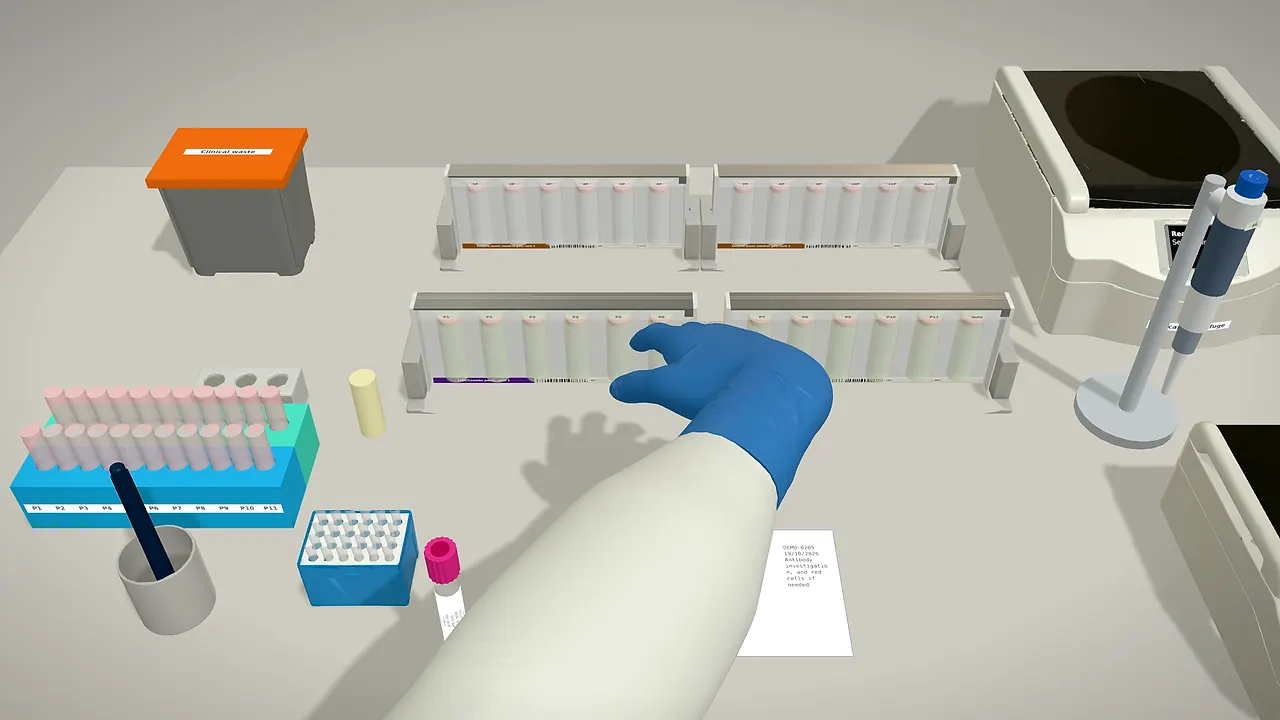
A suggested route
Follow a sample from the request form to a crossmatch. In each procedure, watch Case 1 first, then try it yourself.
Procedures
Showing all 22 procedures, 292 cases.
Pre-analytical
- Sample acceptance22 cases. Procedure version 1.Pre-transfusion sample reception: the tube label against the request and the record, how the tube was labelled, the sample's age and storage against the transfusion and pregnancy history, the group check and one outcome, with unknown patients.Gloved hands in watch mode
- Automated analyser workflow9 cases. Procedure version 1.Running a group and antibody screen on a fully automated analyser: start-up, controls, loading, the run, flags and the repeat list, result review, the rules for manual amendment, authorisation and transfer to the LIMS.Gloved hands in watch mode
- Quality control in the transfusion laboratory13 cases. Procedure version 1.The bench quality control of a hospital transfusion laboratory on the card method: which controls are due, the reagent, card and equipment checks against the laboratory's limits, the grouping and weak screening controls, acting on a failed control and the look-back, new lot acceptance and change control, the records, and UK NEQAS EQA with unsatisfactory and persistent unsatisfactory performance and CAPA. It follows the BCSH 2012 guideline, still current, and the UK NEQAS BTLP manual version 27.Gloved hands in watch mode
Serology
- ABO and RhD grouping23 cases. Procedure version 1.Manual ABO and RhD grouping on a column agglutination card, with reverse grouping, a second anti-D test and the next action for each result.Gloved hands in watch mode
- Antibody screen by IAT13 cases. Procedure version 1.Manual antibody screen by indirect antiglobulin test on a column agglutination card with three screening cells, from the history check to the next action for each result.Gloved hands in watch mode
- Antibody identification10 cases. Procedure version 1.Manual antibody identification with an 11-cell panel and an autocontrol on two column agglutination cards, read with the screening cells, from exclusion and assignment to antigen-negative red cells, the crossmatch route and referral.Gloved hands in watch mode
- Direct antiglobulin test14 cases. Procedure version 1.A manual column agglutination DAT with monospecific anti-IgG and anti-C3d on washed cells, from the history and sample to the pattern, the eluate decision and the next action, including transfusion reactions, cold antibodies and cord samples.Gloved hands in watch mode
- Warm autoantibody investigation in the hospital transfusion laboratory11 cases. Procedure version 1.The hospital transfusion laboratory's part in a patient with a warm autoantibody: recognising the panreactive pattern and its differentials, the history, the Rh and K type or a genotype request, the eluate and adsorption decisions with optional acid elution and alloadsorption, the urgent referral to RCI, the life-threatening pathway, the RCI report, red cell selection and "suitable" labelling. It follows the BCSH 2012 guideline, still current, the BSH 2017 AIHA guideline and the RCI user guide.Gloved hands in watch mode
- Kleihauer FMH estimation and anti-D dose15 cases. Procedure version 1.Manual acid elution (Kleihauer) screening and Miller square count of fetal red cells in a maternal sample, the Mollison calculation, flow cytometry referral at 2 mL or more, the additional anti-D dose and follow-up, including maternal HbF, immune anti-D and samples taken too soon.Gloved hands in watch mode
- Antenatal blood group serology and HDFN risk assessment15 cases. Procedure version 1.The transfusion laboratory's antenatal serology: the booking and 28-week group and screen, fetal RHD screening and prophylaxis for RhD negative women, and, for an antibody, its significance, the fetal antigen status, quantification or titration, the next sample, referral advice, blood for delivery and the cord sample.Gloved hands in watch mode
- Investigation of cold-reacting antibodies in the transfusion laboratory12 cases. Procedure version 1.The hospital transfusion laboratory's part in a sample with a cold-reacting antibody: recognising it in the group, screen, DAT and FBC, resolving the group by a warm wash or a pre-warmed reverse group or referring it, deciding whether a pre-warmed screen is appropriate, clinical significance of anti-M, anti-P1 and anti-Le(a), titre samples, red cell selection and crossmatch, RCI referral and the report. It follows the BCSH 2012 guideline, still current, the BSH 2017 AIHA guideline and the RCI user guide.Gloved hands in watch mode
Issue
- Crossmatch and electronic issue18 cases. Procedure version 1.The issue route decided from the record as the LIMS decides it, from electronic issue to the stop routes, then the IAT crossmatch of antigen-negative units on a column agglutination card with a positive control, to compatible or incompatible units.Gloved hands in watch mode
- Red cell selection and issue18 cases. Procedure version 1.Selecting red cells for a patient by ABO, D and K type and special requirements, choosing units from stock, inspecting, labelling and issuing them with a traceable record, and emergency group O red cells to the national specification before the group is known.Gloved hands in watch mode
- Platelet selection and issue, refractoriness and NAIT13 cases. Procedure version 1.The transfusion laboratory's part in giving platelets: choosing a unit by ABO group, high-titre label, RhD type and special requirements, anti-D advice, alerts and concessionary release, the storage, expiry and visual inspection checks, and issue; then platelet refractoriness with the H&I referral and HLA-selected platelets, and suspected NAIT with HPA-1a and 5b negative platelets. It follows the BSH 2017 and New 2016 guidelines (author and manuscript versions), NHSBT SPN223/13 and INF136/10.Gloved hands in watch mode
- Component preparation and stock management in the hospital transfusion laboratory14 cases. Procedure version 1.The hospital transfusion laboratory's part in the life of a blood component: receiving NHSBT deliveries against their DAT48 limits, storing and monitoring stock, responding to a refrigerator excursion with the PCS13 list, thawing FFP and cryoprecipitate and applying their post-thaw limits, returned units by the 30- and 60-minute rules, rotation and ordering, wastage and WAPI, disposal and traceability. It follows NHSBT SPN223/13, the JPAC Red Book, DAT48/14, the BSMS best practice guide and the Blood Safety and Quality Regulations 2005.Gloved hands in watch mode
Special cases
- Acute transfusion reaction investigation14 cases. Procedure version 1.The transfusion laboratory's investigation of a suspected acute transfusion reaction: severity and whether to investigate, the identity check, the tests the symptoms call for, the returned pack, the DAT, group, screen and crossmatch on the pre- and post-transfusion samples, the blood service, the SHOT category and the haemovigilance reports.Gloved hands in watch mode
- Major haemorrhage protocol: transfusion laboratory response14 cases. Procedure version 1.The transfusion laboratory's response to a major haemorrhage protocol activation: the call, emergency group O and satellite units, the sample under an emergency identifier, the switch to group-specific red cells, plasma, platelets and cryoprecipitate, the results that guide replacement, stock, traceability, stand-down with the return of unused components, and the review. The thresholds come from the BSH 2022 laboratory supplement, the Association of Anaesthetists 2025 guideline and trust documents.Gloved hands in watch mode
- Neonatal and infant transfusion laboratory work14 cases. Procedure version 1.The hospital transfusion laboratory's part of transfusion for recipients under 1 year: the transfusion history including fetal transfusions and transfers, testing mother and infant under 4 months and the 4-month rule, red cells compatible with mother and infant and antigen-negative for maternal antibodies, paedipack allocation, LIMS rules, exchange and large volume units from NHSBT, the neonatal emergency hierarchy, neonatal plasma and platelets, and adult testing from 4 months. It follows the BSH 2016 neonatal guideline with its 2020 addendum, the BCSH 2012 pre-transfusion compatibility guideline, NHSBT SPN223/13 and the Annual SHOT Report 2025.Gloved hands in watch mode
- Transfusion support for haemopoietic stem cell transplant recipients14 cases. Procedure version 1.The hospital transfusion laboratory's part of transfusion support after a haemopoietic stem cell transplant: the transplant protocol on the LIMS and its check against the donor record, classifying the ABO and RhD mismatch, grouping and mixed field with the transplant history, the engraftment criteria and recorded group changes, the transplant phase, red cells, platelets, FFP, cryoprecipitate and granulocytes by phase, irradiation and CMV, acting on LIMS flags, and shared care with referring hospitals. It follows NHSBT SPN215/3, the SHOT checklist on safe transfusions in stem cell transplant recipients (2021), the BCSH 2012 pre-transfusion compatibility guideline, NHSBT SPN223/13 and the Annual SHOT Report 2025.Gloved hands in watch mode
Quality
- Incident and near miss investigation in the hospital transfusion laboratory7 cases. Procedure version 1.The hospital transfusion laboratory's handling of an incident or near miss at the quality office: containment, the local report, the SHOT category and reportability, the SAE or SAR route and its timing, the evidence, contributory factors without blame, root cause and CAPA with an effectiveness check, and closure through governance. It follows the Blood Safety and Quality Regulations 2005, the MHRA and SHOT user guide 2024, the SHOT Definitions 2026 and the UKTLC 2023 standards.
- Change control and validation in the hospital transfusion laboratory4 cases. Procedure version 1.The hospital transfusion laboratory's management of a change to a critical process at the quality office: lot acceptance or a change to revalidate, the change control request and risk assessment, a validation plan with criteria written first, the review of every discordance, sign-off, go or no-go at cutover and monitoring. It follows the BCSH 2012 guideline, the BCSH validation appendices, the BSH 2024 IT guideline appendices and the MHRA guidance on electronic issue.
- IT downtime and power failure in the hospital transfusion laboratory5 cases. Procedure version 1.Keeping the transfusion service safe when the LIMS or all power is unavailable: invoking the plan and suspending electronic issue, the history from the downtime report, issue on paper with a check or the lone-worker route, the power-failure actions, recovery with independent verification and reconciliation, and the de-brief with any ADU report. It follows the UKTLC 2023 standards, the BCSH 2012 guideline, the MHRA guidance on electronic issue and SHOT Safety Notice 01.
How it works
Every case can be taken four ways: Watch, then Guided, Faded and Assessment. Move up as your confidence grows, or go straight to any mode.
- Step 1WatchSee the whole procedure done once, with the reasons.
- Step 2GuidedDo it yourself with hints and feedback at every step.
- Step 3FadedFewer prompts; the hints fall away.
- Step 4AssessmentNo hints. Your result goes on the record.
A 2D view is always one click away and teaches the same steps. It works on lab and university PCs, laptops and tablets, with keyboard and screen reader support.
Practice attempts are private to you. Only assessment results appear on your record, with the date and any critical errors.
Sources and governance
Transfusion Science
Every scored answer links to the UK source it rests on: BSH guidelines, SHOT, the JPAC Red Book and manufacturers' instructions for use.
Content last updated 15 November 2026. Each procedure page carries its own change log.
Something looks wrong? Use Report a problem at any step of the bench, or email [email protected].
These simulations prepare you and build knowledge and confidence. They do not replace supervised practice, observed competence or your local training and SOPs.
Questions
What is the Transfusion Science bench?
The Transfusion Science bench is a simulated hospital laboratory bench with 22 procedures and 292 cases, covering pre-analytical, serology, issue, special cases and quality. Every scored answer links to the UK source it rests on: BSH guidelines, SHOT, the JPAC Red Book and manufacturers' instructions for use.
What are the free cases?
Signed-in learners can try cases 1 to 3 of ABO grouping free, in every mode.
How much does it cost?
£59 a month, including everything in Premium. Renews monthly; cancel any time and keep access to the end of the month you paid for.
How do organisations buy it?
Yes. Each specialty can be added to your organisation's plan as its own line on the quote, priced per seat per year and paid by purchase order and invoice. Members then have it through their membership. Ask for a quote.
What is recorded?
Practice attempts are private to you. Only assessment results appear on your record, with the date and any critical errors.
Prices
- Transfusion Science: £59 a month, includes everything in Premium
Each specialty is its own subscription, so adding one never replaces another. Renews monthly; cancel any time and keep access to the end of the month you paid for.
Universities and NHS organisations add each specialty to their plan as its own line on the quote, priced per seat per year. Ask for a quote.