Cellular Pathology bench
The Cellular Pathology bench is a simulated hospital laboratory bench with 20 procedures and 525 cases, covering specimen reception and cut-up, processing and embedding, sectioning, staining and cytology. Every scored answer links to the source it rests on.
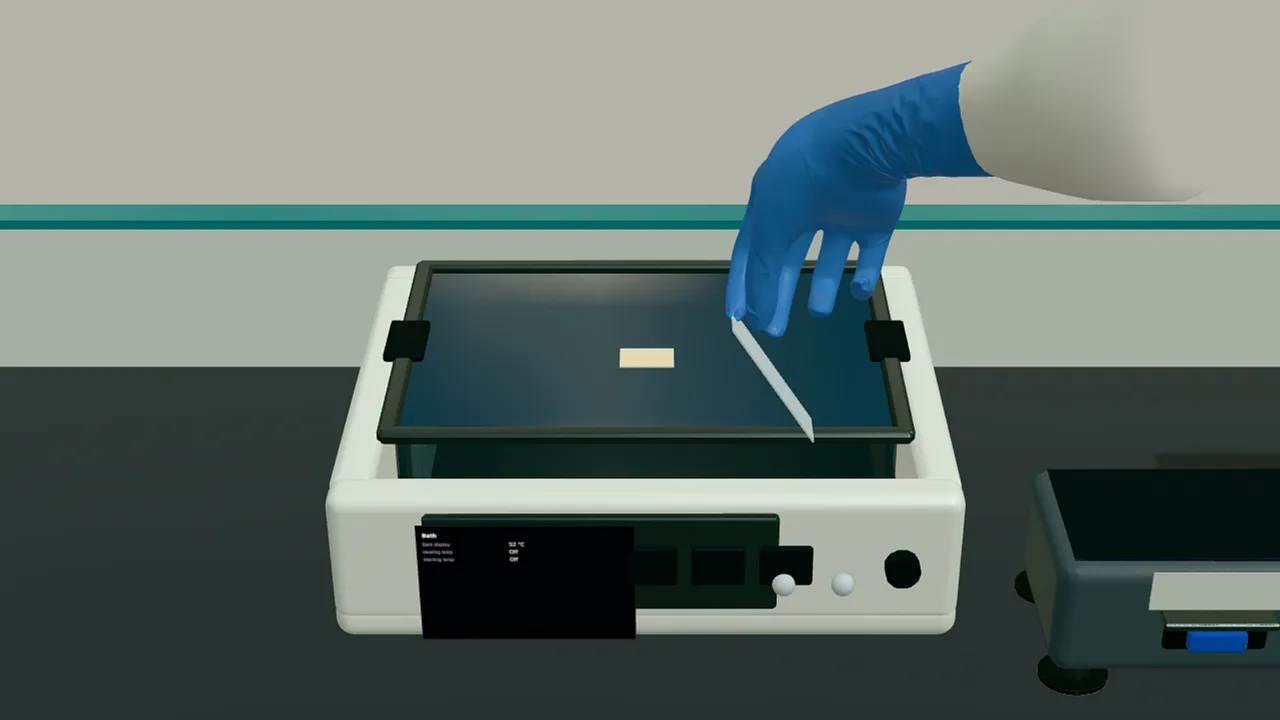
The video has no sound and loops. It shows forceps placing tissue into a cassette at cut-up; a wax block set on the cold plate; the microtome handwheel turned and a section lifted from the flotation bath; a slide rack lowered into the haematoxylin stain; a slide being coverslipped; the cryostat handwheel turned and a section picked up onto a slide in frozen section; the microscope eyepiece and lamp control; a pipette dispensing into a cytology funnel in the safety cabinet; and a slide loaded into the immunostainer.
Procedures
Showing all 20 procedures, 525 cases.
Specimen reception and cut-up
- Histology specimen reception24 cases. Procedure version 4.Histology specimen reception on a per-case example SOP card: the carrier, priority, form, bag, identity, specimen, fixative and fixation time, read in the order they are met, to one primary decision, who is told, the accession number and the record. The card follows the IBMS minimum list, and its local lines are examples.Gloved hands in watch mode
- Fixation and cut-up31 cases. Procedure version 4.Fixation and cut-up on a per-case example SOP card: the bench, identity, category and role, the preview, the form and the fixation time, read in the order they are met, to one primary decision, then transfer, keep fixing, refer or hold. The card lines are examples, and this bench gives no qualification or authorisation to dissect.Gloved hands in watch mode
- Block and slide archive21 cases. Procedure version 3.The block and slide archive on a per-case example SOP card: file blocks and slides, send material on a request, check a returned parcel, or work the disposal list for wet tissue, then file, send, file back, dispose, keep or hold, with the labels, lists, log and pot drawn in code.
Processing and embedding
- Tissue processing33 cases. Procedure version 5.Tissue processing on a per-case example SOP card: read the tray, the screen, the log and the run report, choose the run, decide, and load or recover, on a closed processor drawn with no brand.Gloved hands in watch mode
- Embedding24 cases. Procedure version 6.Embedding on a per-case example SOP card: read the centre, the tray, the forceps and the list, open the next cassette, decide, make the block, and check finished blocks, at an embedding centre drawn with no brand.Gloved hands in watch mode
- Microtomy and flotation33 cases. Procedure version 7.Microtomy and flotation on a per-case example SOP card: read the bath, the water, the oven, the blade and the list, decide, set up, trim, cut, float, pick up and dry, and check ribbons and slides, at a rotary microtome drawn with no brand.Gloved hands in watch mode
- Decalcification34 cases. Procedure version 6.Decalcification on a per-case example SOP card: read the fume cupboard, the form, the note, the log, the specimen and the end point, decide whether a specimen goes into fluid, finishes, carries on or stops, name why it stops, and surface decalcify a returned block, at a station drawn with no brand.Gloved hands in watch mode
- Start-of-day upkeep round14 cases. Procedure version 3.The start-of-day upkeep round on a per-case example SOP card: a stainer station, the processor's bottles, wax and condensate, a working solution, formalin pots under extraction or the morning's readings, read and then left, refilled, replaced, topped up, made, started or stopped, with the screens, labels and log drawn in code.Gloved hands in watch mode
Sectioning
- Frozen section34 cases. Procedure version 5.A frozen section on a per-case example SOP card: read the request and the cryostat, decide whether it goes ahead, mount, cut and stain, read the section at the blade, and leave the tissue and the chamber right, at a cryostat drawn with no brand.Gloved hands in watch mode
- Sections for molecular testing15 cases. Procedure version 3.Sections for molecular testing on a per-case example SOP card: read the request, the pathologist's tumour content, the block and the tissue left, then cut scrolls or slide-mounted sections cleanly under the right label, or check a set and send it on, put it right or stop, with the request, block face and labels drawn in code.Gloved hands in watch mode
Staining
- H&E staining and QC17 cases. Procedure version 5.A manual regressive Harris H&E run on a per-case example SOP card, then microscopic QC of the stained section and the control beside a reference: Q1 to Q10, one verdict, the likely cause, the primary decision and the follow-on actions, the record and the chemical waste route. Times are one manufacturer's example, and the criteria borrow the UK NEQAS description of a good slide.Gloved hands in watch mode
- Special stains32 cases. Procedure version 8.Special stains on a per-case example SOP card: read the request, the control rack and the reagents, or read the control before the patient slide, then proceed, repeat, recut, release or stop, on six stains drawn in code.Gloved hands in watch mode
- Immunohistochemistry31 cases. Procedure version 6.Immunohistochemistry on a per-case example SOP card: read the lot, the controls, the fixation clock and the section before a run, or read the positive, negative and internal controls before the patient slide, then proceed, repeat, recut, release with no score or stop, at an immunostainer drawn with no brand.Gloved hands in watch mode
- Microscope set-up14 cases. Procedure version 2.Microscope set-up on a per-case example SOP card: set up Köhler illumination in the order two makers agree on, find what spoils a view and put it right or report it, or end a session with the cleaning a user may do, at a microscope drawn with no brand and a view drawn in code.Gloved hands in watch mode
- Whole slide scanning and scan quality control15 cases. Procedure version 2.Whole slide scanning on a per-case example SOP card: check a slide is fit to scan and load it, or check a scanned image against its glass, then release, rescan, wipe, reload, return or stop, with the slide, the macro image, the image and the rack drawn in code.Gloved hands in watch mode
Cytology
- Non-gynaecological cytology32 cases. Procedure version 6.Non-gynaecological cytology preparation on a per-case example SOP card: read a fluid, spread slides or a returned preparation, then process, stain, prepare again, pass on with no opinion or stop, with the cabinet, the sealed head and the cytospin spot drawn in code.Gloved hands in watch mode
- Cervical sample acceptance47 cases. Procedure version 4.Cervical sample acceptance and the HPV pathway for England: read a clinician taken vial, a returned self-test kit or a result ready to route, then accept, log, test for a limited report, report HPV-U, keep, reject or route, with the vial, the kit, the form and the results screen drawn in code.
- LBC and Pap32 cases. Procedure version 3.Liquid based cytology preparation and Papanicolaou staining on a per-case example card: check a batch before it is loaded, read a batch report line, or read the technical quality of a stained slide, then go on, correct, re-coverslip or stop, with no opinion on the cells, at a processor drawn with no brand.Gloved hands in watch mode
- Cervical screening27 cases. Procedure version 4.Cervical cytology slide reading on the England primary hrHPV pathway: check a ThinPrep slide against its request and the LIMS, screen the whole deposit or hold the slide, count where adequacy is in doubt, classify what is stated in the programme's terms and result codes, and send the slide for quality control, to the checker or to the senior. With rapid review and two desk cases.
- FNA clinic preparation and cell block15 cases. Procedure version 2.FNA clinic preparation and cell block on a per-case example SOP card: label, spread, dry, fix, rinse, stain and pack at a clinic with no opinion on adequacy, or make a cell block from a needle rinse by the card's plasma and thrombin method, or stop, with the slides, pots, tubes and cassette drawn in code.Gloved hands in watch mode
How it works
Every case can be taken four ways: Watch, then Guided, Faded and Assessment. Move up as your confidence grows, or go straight to any mode.
- Step 1WatchSee the whole procedure done once, with the reasons.
- Step 2GuidedDo it yourself with hints and feedback at every step.
- Step 3FadedFewer prompts; the hints fall away.
- Step 4AssessmentNo hints. Your result goes on the record.
A 2D view is always one click away and teaches the same steps. It works on lab and university PCs, laptops and tablets, with keyboard and screen reader support.
Practice attempts are private to you. Only assessment results appear on your record, with the date and any critical errors.
Sources and governance
Cellular Pathology
Every scored answer links to the source it rests on.
Content last updated 18 November 2026. Each procedure page carries its own change log.
Something looks wrong? Use Report a problem at any step of the bench, or email [email protected].
These simulations prepare you and build knowledge and confidence. They do not replace supervised practice, observed competence or your local training and SOPs.
Questions
What is the Cellular Pathology bench?
The Cellular Pathology bench is a simulated hospital laboratory bench with 20 procedures and 525 cases, covering specimen reception and cut-up, processing and embedding, sectioning, staining and cytology. Every scored answer links to the source it rests on.
What are the free cases?
Signed-in learners can try cases 1 to 3 of H&E staining free, in every mode.
How much does it cost?
£59 a month, including everything in Premium. Renews monthly; cancel any time and keep access to the end of the month you paid for.
How do organisations buy it?
Yes. Each specialty can be added to your organisation's plan as its own line on the quote, priced per seat per year and paid by purchase order and invoice. Members then have it through their membership. Ask for a quote.
What is recorded?
Practice attempts are private to you. Only assessment results appear on your record, with the date and any critical errors.
Prices
- Cellular Pathology: £59 a month, includes everything in Premium
Each specialty is its own subscription, so adding one never replaces another. Renews monthly; cancel any time and keep access to the end of the month you paid for.
Universities and NHS organisations add each specialty to their plan as its own line on the quote, priced per seat per year. Ask for a quote.